Fox Valley Science Society
First Wednesday of Each Month
|
6:00 pm
|
First Wednesday of Each Month | 6:00 pm |
The Fox Valley Science Society is a community for curious minds. If you're a scientist, a lifelong nerd, or simply someone who loves asking good questions and following where they lead, this is your place.
As a fiscally sponsored organization, we're committed to keeping science accessible to everyone. Our programs are supported through community donations rather than required admission fees. We suggest a $5 donation, but you're welcome to give whatever you're able, or whatever you feel the program is worth. Every contribution helps support speakers, educational programming, and future events while ensuring no one is turned away because of cost.
We host informal talks, discussions, and events centered around science, critical thinking, and curiosity about the world. Topics range widely and accessibly, with an emphasis on learning together rather than lecturing at one another. No lab coat required.
This is a welcoming, inclusive, and neurodivergent-friendly space where it's okay to get excited, go deep, ask, "Wait, how does that actually work?", and occasionally nerd out a little too hard. All backgrounds, identities, and levels of expertise are welcome, as long as you come in good faith and with respect for others.
If you like science, conversation, and community (and maybe a beverage while you're at it), you've found your people.
Can't make it in person? We've got you covered. We try our hardest to record the presentations. Recordings are available for purchase in our online shop so you can learn from wherever you are.
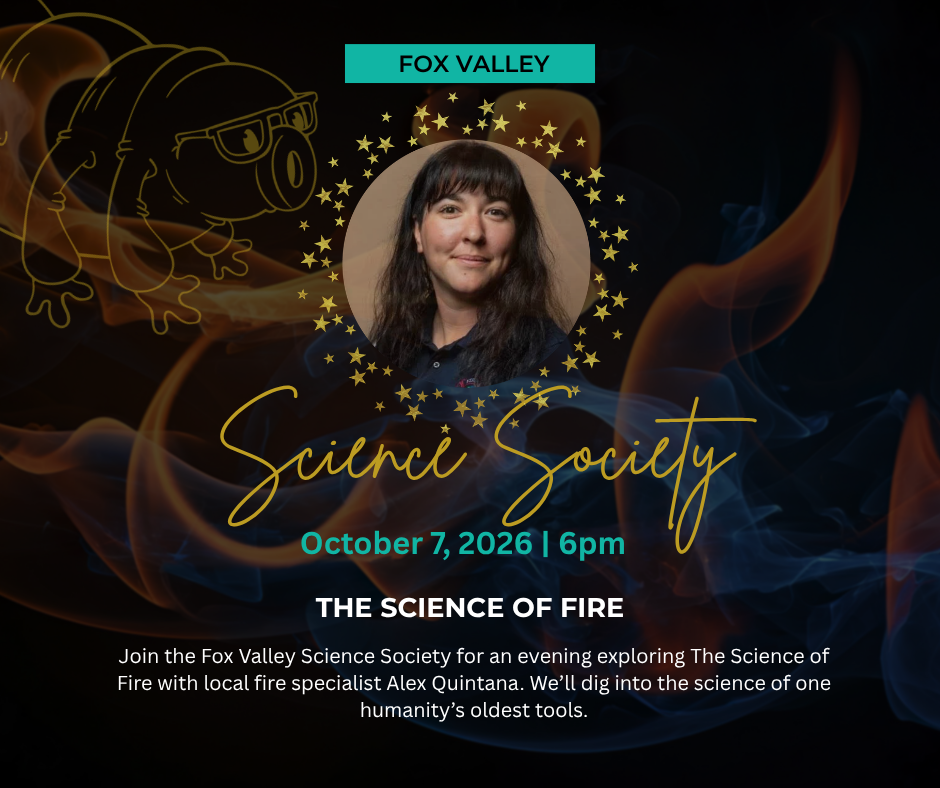
October Speaker
The Science of Fire
October 7, 2026 at 6:00pm
Fire may be familiar, but what is actually happening when something burns?
In this introduction to fire science, Alex Quintana of the Appleton Fire Department will explore what fire needs, how heat travels, why smoke behaves the way it does, and how a small flame can become a rapidly developing room fire. Along the way, we will examine ventilation, modern furnishings, and how firefighters use science to influence fire behavior.
Then we will turn up the heat with lithium-ion batteries. These compact power sources are found in phones, laptops, tools, e-bikes, and countless other devices, but damage, improper charging, or manufacturing defects can lead to thermal runaway and rapidly escalating fires.
Presented during Fire Prevention Week, this talk combines practical safety information with the science behind combustion and battery failure. Expect videos of varying production quality, outdated pop culture references, audience participation, and enough dark humor to make everyone slightly concerned about giving Alex a microphone.
Speaker Bio:
Alex Quintana (she/her) is the Public Education Specialist, Fire Inspector, and Public Information Officer for the Appleton Fire Department. She has worked in the fire service since 2019 and previously served as a firefighter. Her work focuses on fire and life safety education, community risk reduction, fire prevention, inspections, and public communication. Alex also serves as an adjunct fire service instructor and enjoys making fire science understandable, practical, and a little more entertaining than most people expect. She is a U.S. Navy veteran and holds degrees in Fire Protection and Accounting.
November Speaker
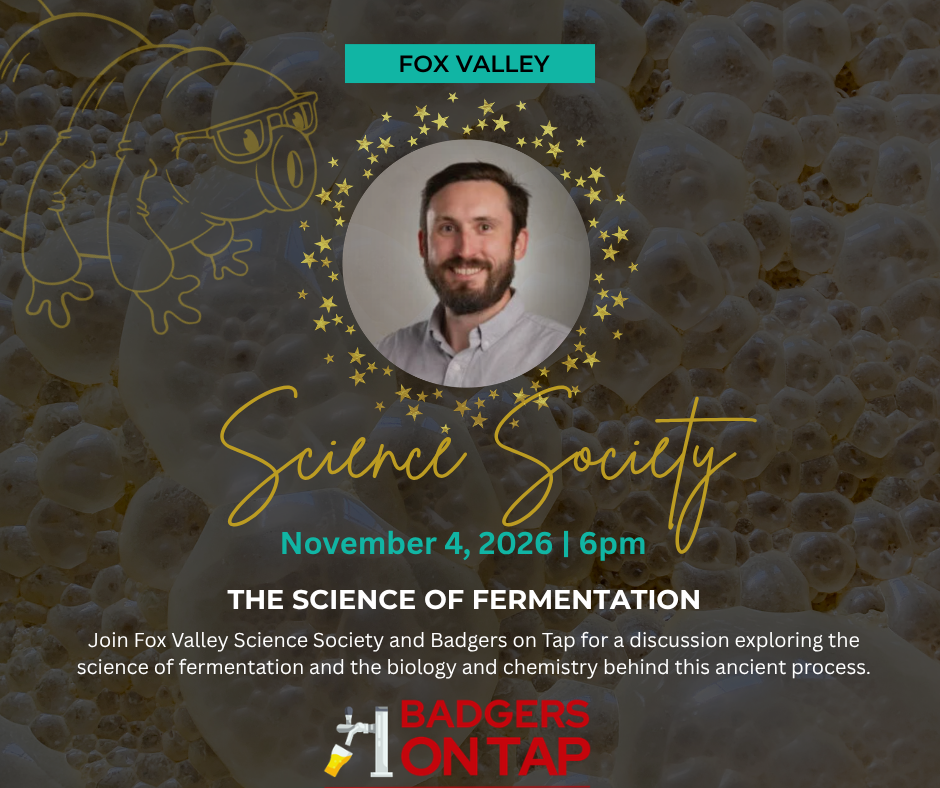
The Science of Fermentation
November, 2026 at 6:00pm
Speaker Bio:
David J. Krause, Ph.D. is an Assistant Professor of Biology at the University of Wisconsin–Oshkosh specializing in microbiology. His research explores the remarkable metabolic diversity of budding yeasts, including how different species have evolved the ability to grow without oxygen. His lab uses genetics, genomics, and experimental evolution to better understand the biology and evolution of yeast—tiny organisms responsible for some very important science, including fermentation.
December Speaker
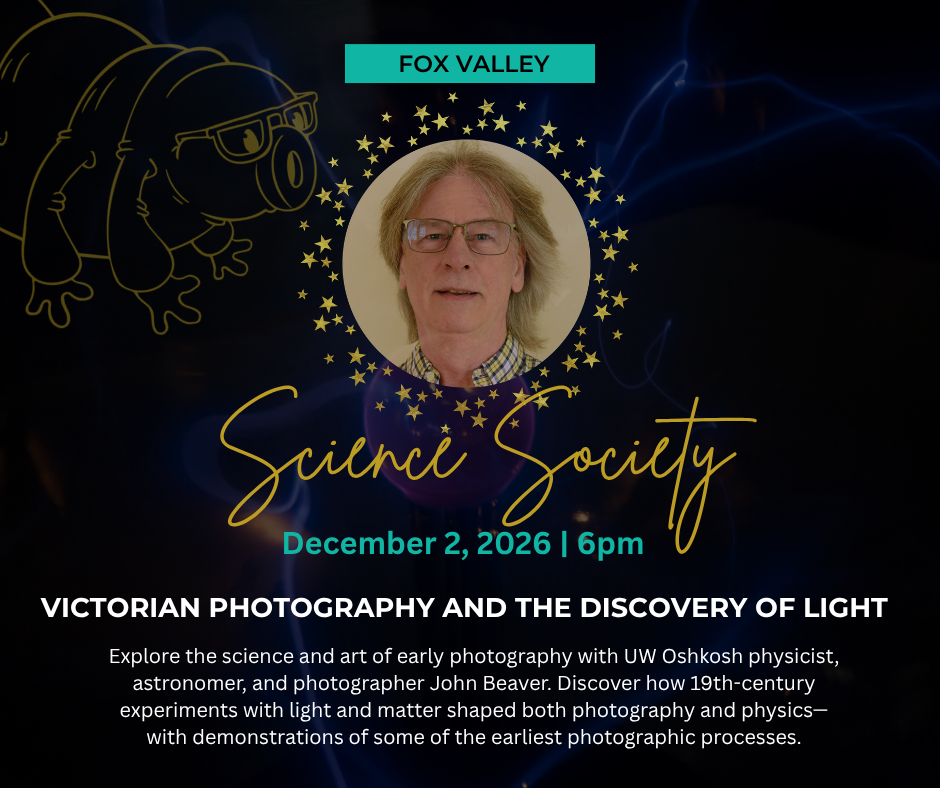
Victorian Photography and the Discovery of Light
December 2, 2026 at 6:00pm
Description:The early history of photography ran parallel to a revolution in our understanding of the nature of light, and some of the same individuals were important for both. Here I describe (and demonstrate) some of the earliest photographic processes, while recounting some of the history of the evolution of our understanding of light and its interaction with matter, paying particular attention to the work of the important 19th century British scientists John Herschel and Mary Somerville.
Bio:
John Beaver is Professor of Physics and Astronomy at UW Oshkosh. He earned his B.S. in physics from Youngstown State University and his PhD in Astronomy from Ohio State. Beaver has long been a practicing art photographer, specializing in historical and experimental processes. Over the past quarter century, his photography has been seen in nearly three dozen joint and solo exhibitions and juried group shows. He is the author of six books, most recently Lo-Fi Photography: Art from Do-it-Yourself Chemistry and Physics.
Powered by Community.
Guided by Science.
Because science belongs to everyone.
Thanks to our fiscal sponsor, Compassionate Home Healthcare, FVSS presentations are supported by community donations rather than a fixed admission fee. Your contribution helps cover potential speaker expenses, venue costs, and allows the FVSS to continue offering accessible, science-based programming for everyone. If $5 isn't reasonable for your circumstances, please give what you can, or whatever you feel the program is worth. Every donation helps make future presentations possible.
Take a Seat. Support the Mission.
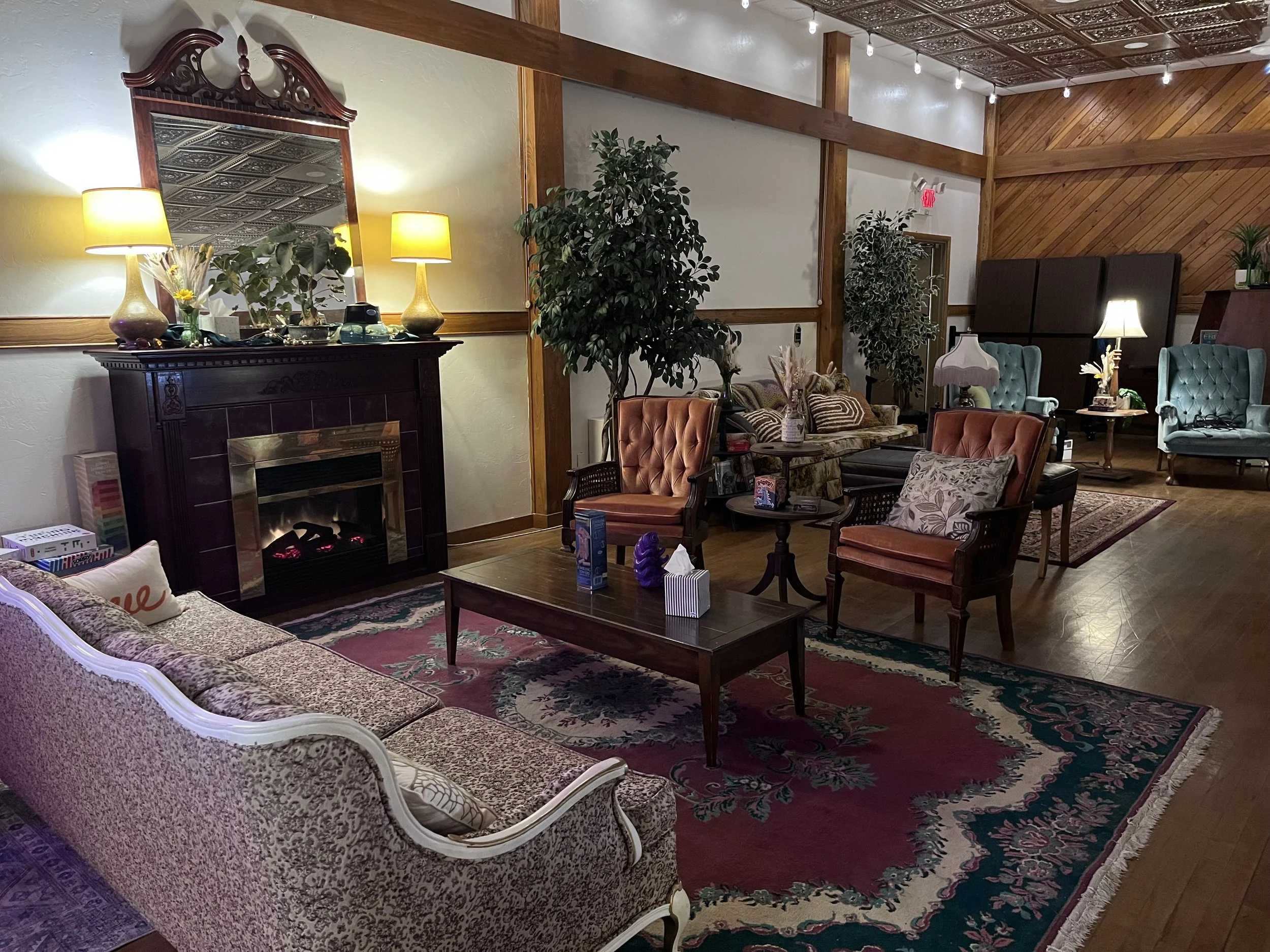
Our furniture finally decided it was time to start earning rent.
Bid on one of Tardigrade's gloriously cozy vintage sofas and chairs for VIP seating at select events. You're bidding for the privilege of lounging during the event—not taking the furniture home. Every winning bid helps fund our community mission, supporting free and low-cost educational programming, LGBTQ+ gatherings, mutual aid efforts, and other community initiatives that make the Fox Valley a more welcoming place.
Browse the current auctions below, find your favorite seat, and may the coziest bidder win.
Recordings of Presentations
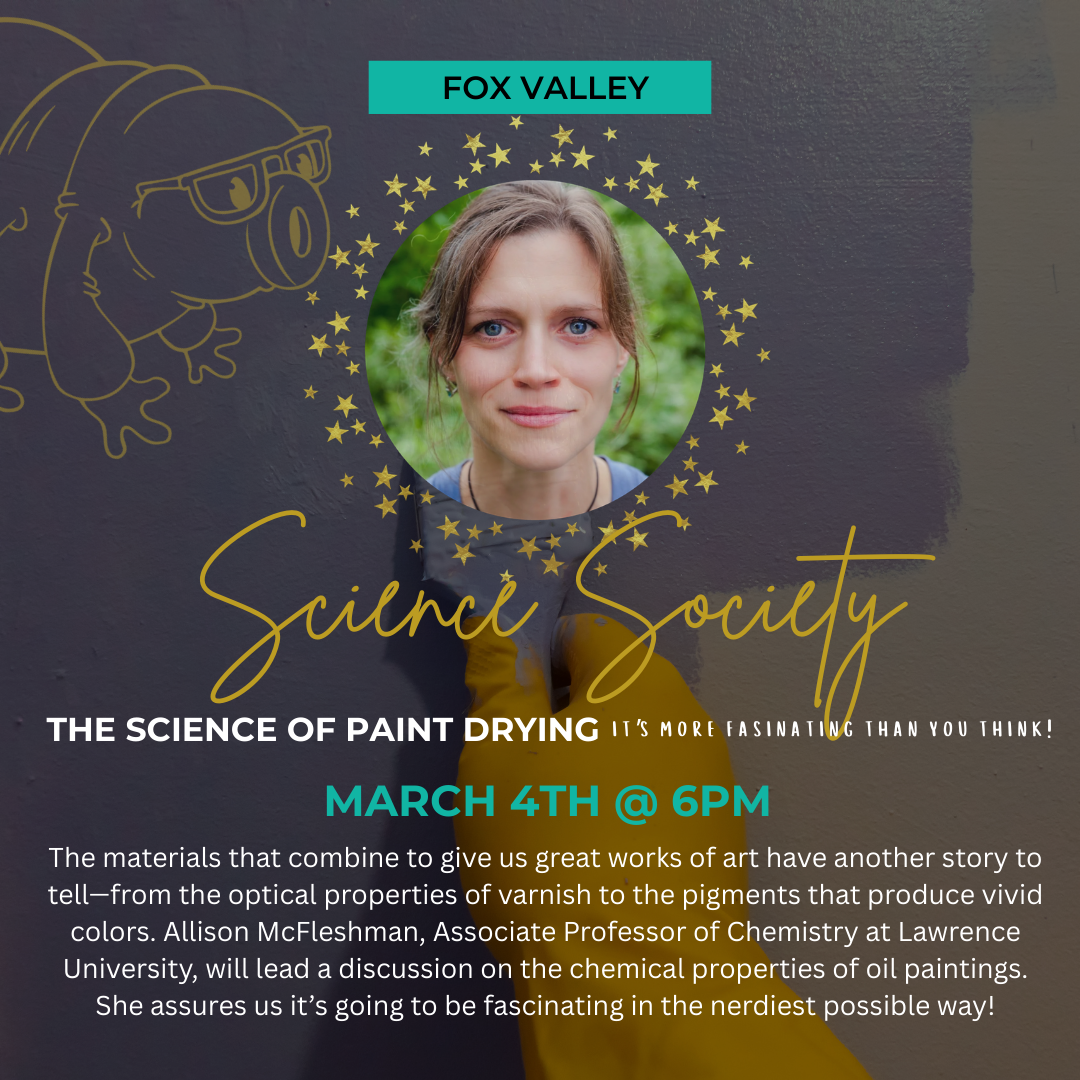
Science of Paint Drying - It’s more fascinating than it sounds!
The materials that combine to give us great works of art have another story to tell. From the optical properties of the varnish, to the pigments that produces the vivid colors, I will lead you through a discussion on the different chemical properties of oil paintings. I spent last year watching paint dry, and I assure you, it is quite a fascinating endeavor!
About the speaker:
Allison McFleshman, Associate Professor of Chemistry Lawrence University, earned her Bachelor’s of Physics and PhD in Chemistry from the University of Oklahoma. Teaches classes in thermodynamics and quantum mechanics, as well as the chemistry of art. Research interests include studying fluid dynamics on a molecular level and investigating pigments from medieval manuscripts. She also co-owns McFleshamn’s Brewing Co with her husband.
After purchasing, you will be provided a QR code link to view the presentation. Thank you for your support!
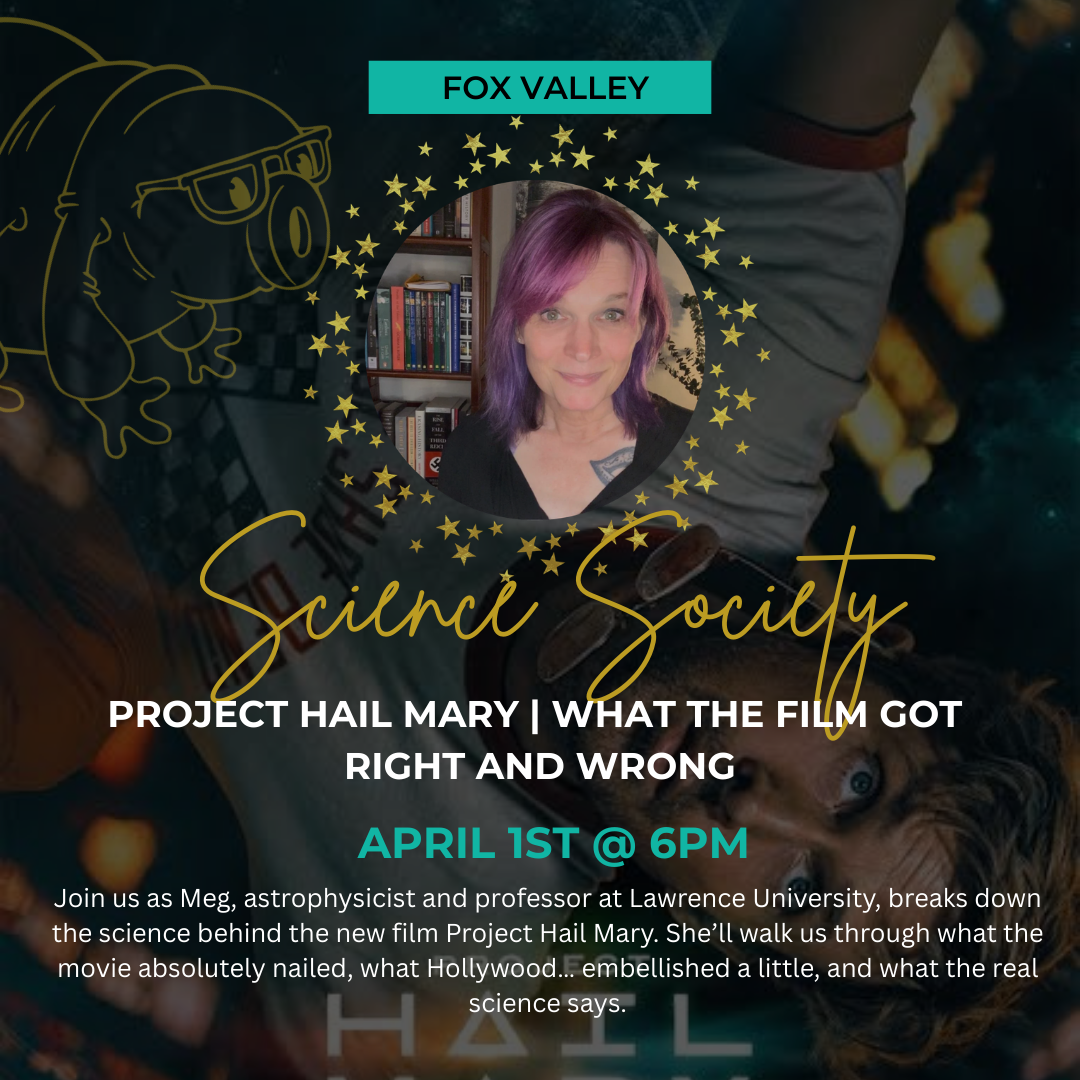
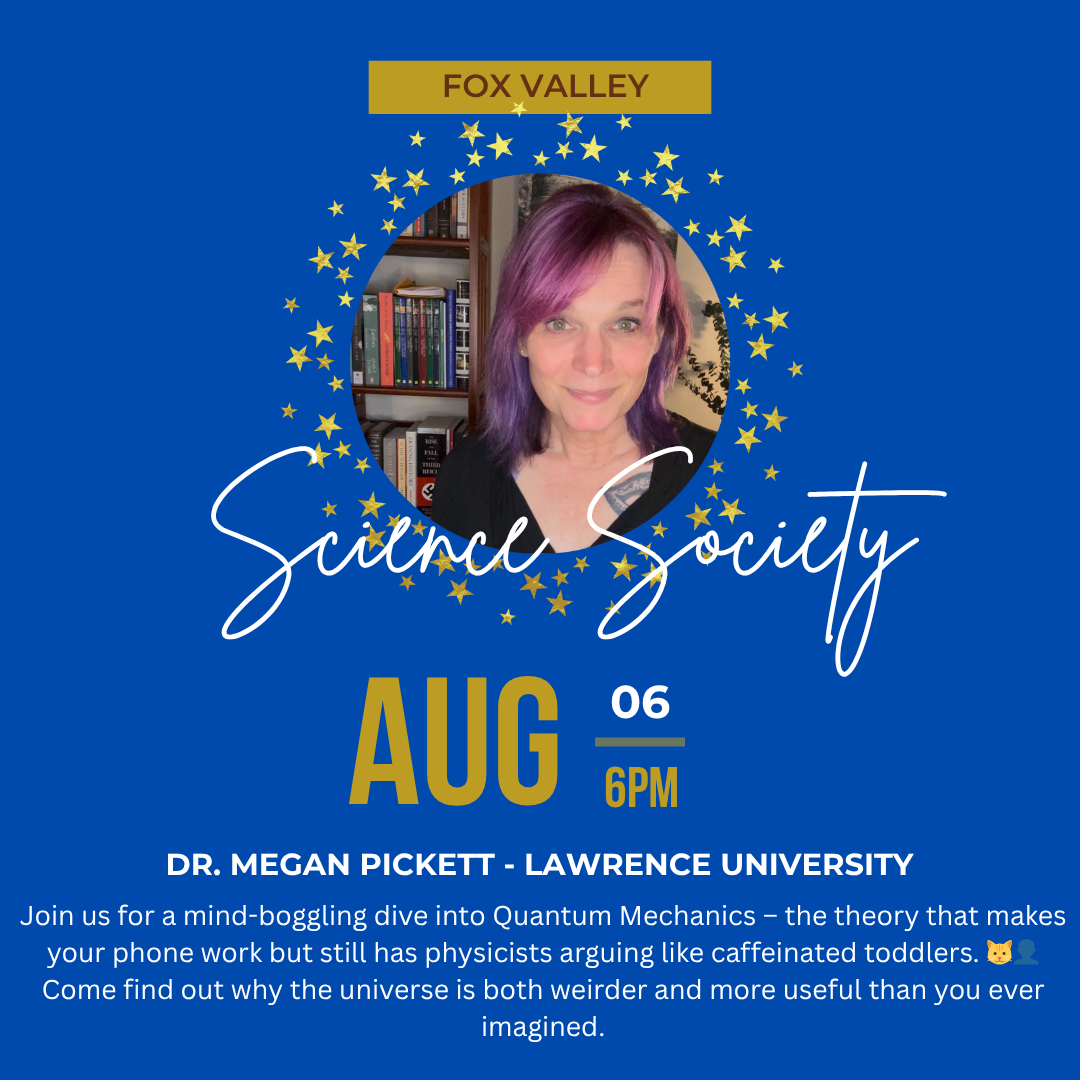
Andy Weir has become famous for his meticulously researched speculative fiction that features competent, but very human, scientists working seemingly impossible problems, all while hewing as closely as possible to known science and technology. In his latest book, Project Hail Mary, Weir has raised the stakes from saving a single stranded astronaut (The Martian) to an interstellar long shot mission to save the Earth—and our stellar neighbors. The heart of the story is two explorers, Dr. Ryland Grace of Earth and Rocky from 40 Eridani A, and their missions to tau Ceti. Along the way, Weir leans into what we know and what we might guess about the cosmos, and how competence and curiosity are universal.
Meg’s talk focuses on the astronomy and physics of Project Hail Mary, which range from well-known and exciting discoveries in science and technology to the more speculative leaps in imagination.
If you missed the live presentation in April, this recording is a great way to be part of the community conversation.
After purchasing, you will be provided a QR code link to view the presentation.
About the speaker:
Dr. Megan Pickett is an associate professor of physics and chair of the Physics Department at Lawrence University. She earned her BA in Physics at Cornell University in 1988 and MA and PhD in Astrophysics in from Indiana University in 1995. After IU, she was a National Research Council Fellow at NASA’s Ames Research Center until 1999, when she began her teaching career at Valparaiso University, Purdue University, and ultimately Lawrence University. She has written more than two dozen papers on the origins of Solar Systems and Gas Giant planets, as well as receiving several NASA and NSF grants. While at Lawrence, she has been awarded the First Year Studies Teaching Award, the Early Career Teaching Award, The Award for Teaching Excellence, and the Honors Faculty Convocation Award, which was later adapted into a TED talk (https://youtu.be/eYC93oQURPc). A native of Madison, she has worked in New York, Indiana, California, Washington, Munich, and Yorkshire.
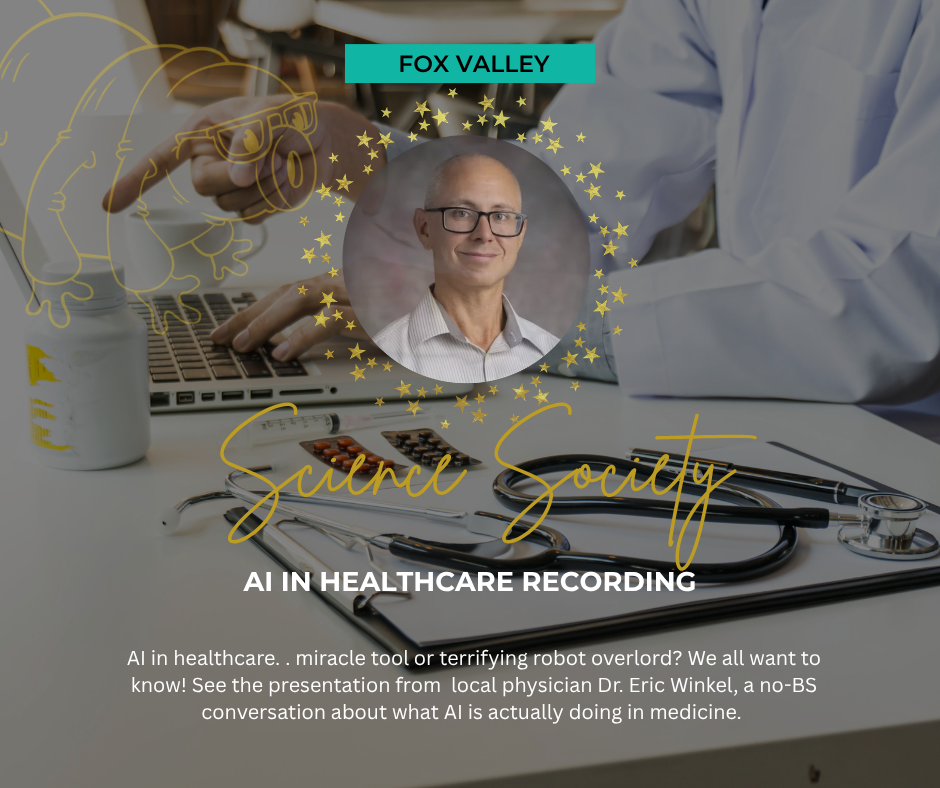
AI in healthcare: miracle tool or terrifying robot overlord? Honestly, we’d all like to know.
See the presentation by local physician Dr. Eric Winkel, a no-BS conversation about what AI is actually doing in medicine right now. . .Startling breakthroughs to the very real questions surrounding the future of medical care. Explore how AI could reshape healthcare and what previous waves of technological disruption can teach us about what comes next.
Speaker Bio
Dr. Eric Winkel practices general hospital medicine at ThedaCare Regional Medical Center in Appleton and Neenah, and serves as Associate Program Director for ThedaCare’s new Internal Medicine Residency Program, welcoming its first residents in July 2026.
Past Presentations